
A Bit of Whimsy
You may be an old timer if
Your joints are slow and stiff,
You remember Heath,
Have two false teeth,
And are happily radio-active.
(If you’re not an old timer, just give it a while.)
Thoughts on Winlink for EmComms
Sometimes I listen to the Beehive Utah Net, which meets daily on 7272 KHz at 12:30 p.m. local time. It’s part of the ARRL National Traffic System, and is very businesslike in its approach to handling message traffic. I look at the people who regularly participate, and think of them as generous, maybe even noble, for their unseen, unsung community contribution. I also think that the whole operation is highly inefficient. It involves many people, each giving an hour of their time and energy, to pass a small number of messages that could better be handled by other means, even in an emergency.
In contrast, Winlink is a highly efficient amateur radio email system, with hundreds of automated stations, that works even if the internet doesn’t. It’s accessible to all license classes, and runs on HF and VHF. It will allow you to send an email by radio to anyone who has internet service and an email address. It will also allow an amateur to receive emails even if no internet is available locally. Of course, you can also directly connect with Winlink via the internet if that is what you choose.
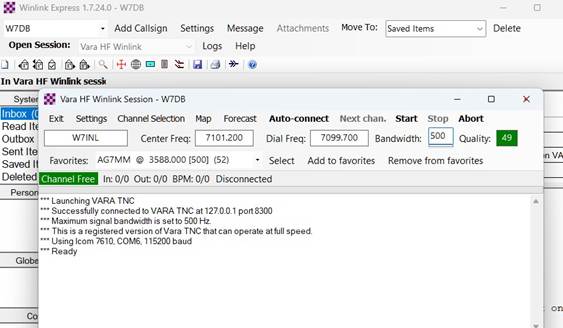
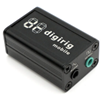
If you are set up for FT-8, you already have the radio-computer interface that you need. Just download and install Winlink. No FT-8? Newer transceivers already have sound cards, so you just need a USB cable. If yours doesn’t, you’ll need a DigiRig (https://digirig.net/) or similar interface and cable. That option also works for your 2 meter HT. I installed Winlink so long ago that I don’t remember whether it will work without making a contribution, but I think it will. I thought it was a worthwhile operation, so I chipped in.
Winlink includes ARDOP, a native sound card program. It is an HF-only program. VARA and VARA FM are much better programs that smoothly add-in and cover both HF and VHF. The free version of VARA is perfectly adequate, but it will nag you to upgrade each time it opens if you continue with the free version.
You’ll need to designate up to three Message Pickup Stations. When you have an incoming message, it will be distributed to these stations, where you can pick it up via radio. You’ll want to choose stations designated with an H for this purpose. So if Utah is struck by an earthquake, you can email your Aunt Alice in Adelaide, and still receive her response, even with no Utah internet or phone service.
Locally, we have 2 meter FM portals. Worldwide, there are very many HF portals. So, like amateur radio in general, it is a very resilient system.
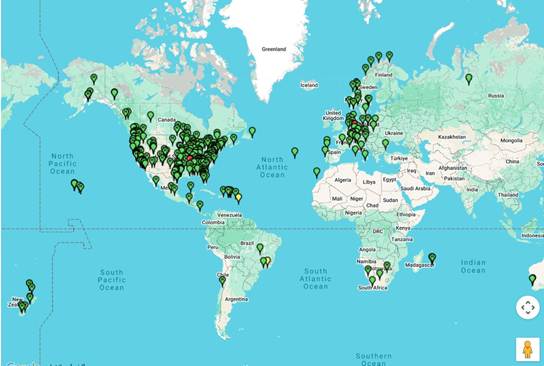
It’s a good idea to try out connections to several stations on different bands, and add them to your favorites list. HF connections will work just fine with SSB bandwidth on receive. But if you can engage a 500 Hz filter and center it in the audio passband, it will work a bit better.
With all that done, you have a resilient system that will get you connected to the non-ham world if traditional methods aren’t working.
73 for now,
Denton
W7DB