
Denton’s Corner

Whimsy is at the end of the article.
Fun With Ferrites
At one of our meetings, Joe pointed out that coaxial cable really has three conductors: the inner conductor, the inner surface of the shield, and the outer surface of the shield. This can lead to problems with unwanted currents as the coax tries to be a ground radial or a radiating element. That creates the need for coax chokes. More often than most people realize, you need chokes, whether you’re operating on HF or VHF. This article is a short summary of what I’ve found about ferrite coax chokes.
If you want to skip the rest of the article, the short answer is Type 31 Fair-Rite snap-on chokes from Mouser Electronics. They outperform everything I have tested, and the prices and shipping costs are favorable.
Don’t waste time with cheap no-name snap-ons from eBay. They don’t cost much, but the ones I have tested performed poorly.
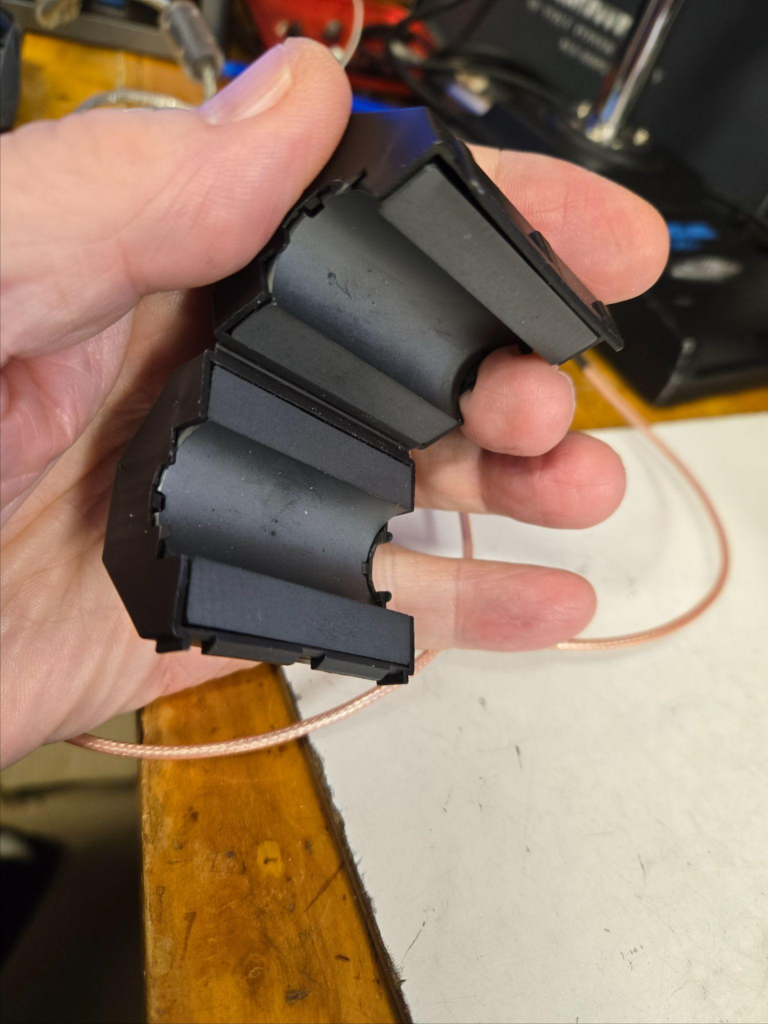
Why snap-on and not slip-on? Ferrite is brittle as glass, and the plastic cage provides insurance against breakage. Further, you can put them on or take them off when the connectors are already in place. It’s just a better arrangement.
One good solution is a jumbo Type 31 core, Mouser part number 623-0431176451. The center is large enough for 3 turns of RG58, or probably RG8X. That creates a formidable choke with only one core costing about $10.
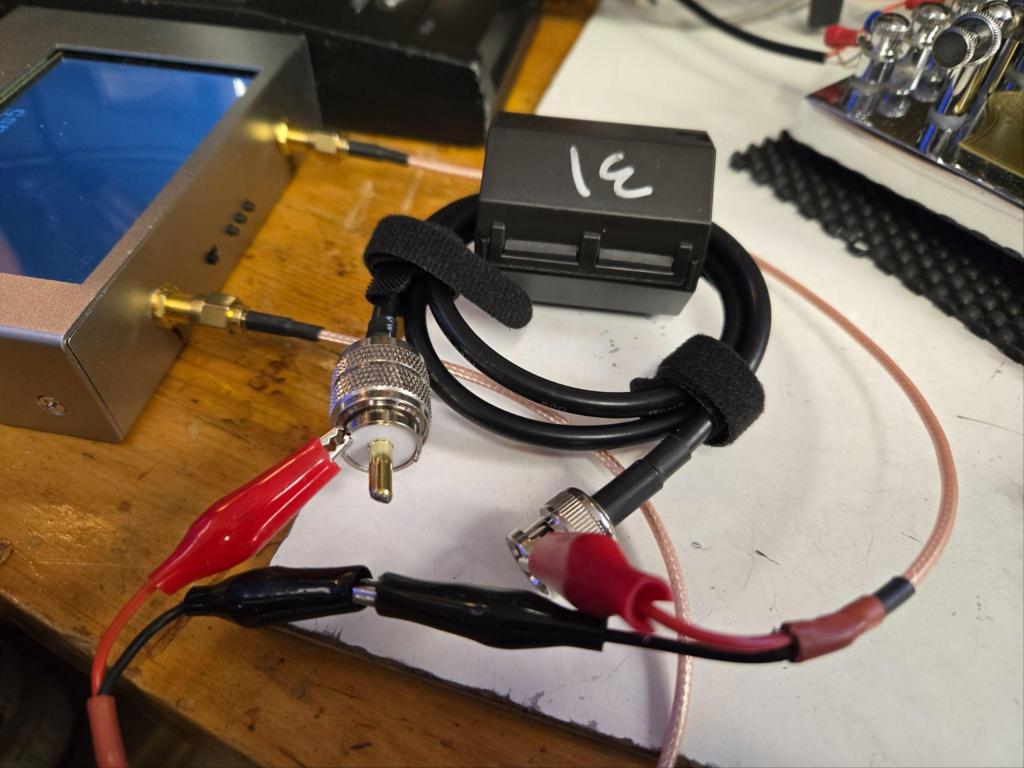
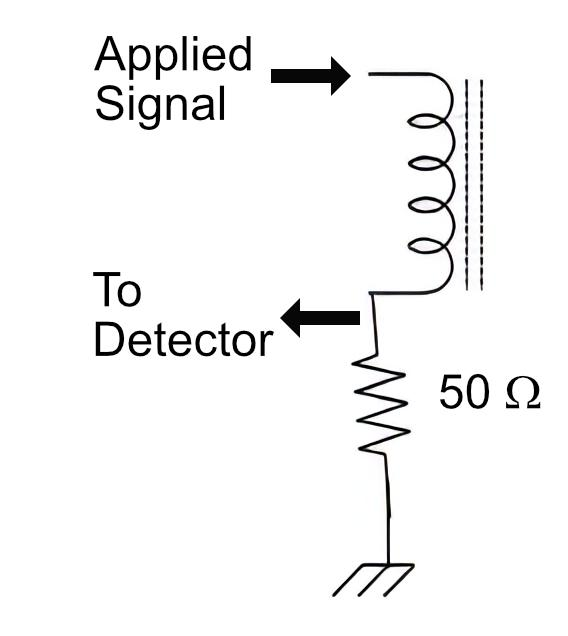
The Vector Network Analyzer applies a test signal to the shield at one end, and a detector to the shield at the other end. This forms a simple voltage divider with the choke and the internal 50 ohm termination inside the Vector Network Analyzer. The result is displayed as dB of loss, input vs. output. It’s a good way to compare chokes, although your real world results will depend on how the outer surface of the coax is terminated. If your station has a solid Earth ground, the resistive portion of the divider will be close to zero, and your results will be better than what the VNA says. If you’re not grounded……. Well, that could be more sporting.
For comparison, I also spot checked the same coax with 5 regular size cores, just large enough for one RG-58 or RG-8X coax pass through the core, Mouser part number 623-0431164281, about $2 each.
| Band | dB Isolation, Jumbo Core, 3 Loops | dB Isolation, 5 RG-8X/RG-58 Cores |
| 160 | -19.4 | -11.5 |
| 80 | -23.2 | |
| 60 | -24.9 | |
| 40 | -25.7 | -19.0 |
| 30 | -27.2 | |
| 20 | -29.0 | |
| 17 | -30.4 | |
| 15 | -31.1 | |
| 12 | -31.4 | |
| 10 | -31.3 | -25.3 |
| 6 | -34.8 | -35.9 |
| 2 | -19.5 | -15.4 |
| 70 cm | -24.0 | -27.1 |
20 dB is substantial isolation. 30 dB is impressive!
The jumbo core is probably the best solution for HF, at the lowest cost. Regular size cores are probably better behaved at VHF, due to intra-winding capacitance in a 3 turn jumbo core.
Coax chokes are sometimes called common mode chokes, which they definitely are not. Sometimes they are called baluns, which isn’t quite exactly right either. But that’s a longer conversation.
Today’s Whimsy
A component that's dark and quite round,
A good EMI dampener is found.
When your RF’s a mess,
And causes distress,
The coaxial choke puts the buzz out of bounds.
73 for now,
Denton
W7DB