
Notes On Portable Operation Equipment
It’s a good idea to have portable equipment that can be quickly pressed into service in case of an emergency, and it’s fun to have it ready for field day, vacations, and POTA. Herewith a couple of notes from my much less than universal and admittedly biased experience.
Many of the “go kits” we see are VHF/UHF only. That’s probably what is needed in case of a disaster, and will serve well if it is necessary to set up temporary operations at one of the 15 municipalities in Davis County or one of the affiliated schools, hospitals, refineries, or water treatment operations. If your interests extend beyond local emergency response, an HF solution is worth considering.
My basic transceiver for portable operation has been the older Icom IC-706 Mark ii G, which does all modes on bands from 160 meters to 70 centimeters. A more recent offering from Icom is the IC-7000 which has the same functions in the same size package, with some useful improvements including a more versatile filter arrangement. The 706 is a well loved product, one of the best selling of its era. They can be had used for around $600 ($100 more with 500 Hz filter), while the 7000 usually goes for about $100 more. This gives you full function, full power HF and VHF/UHF.
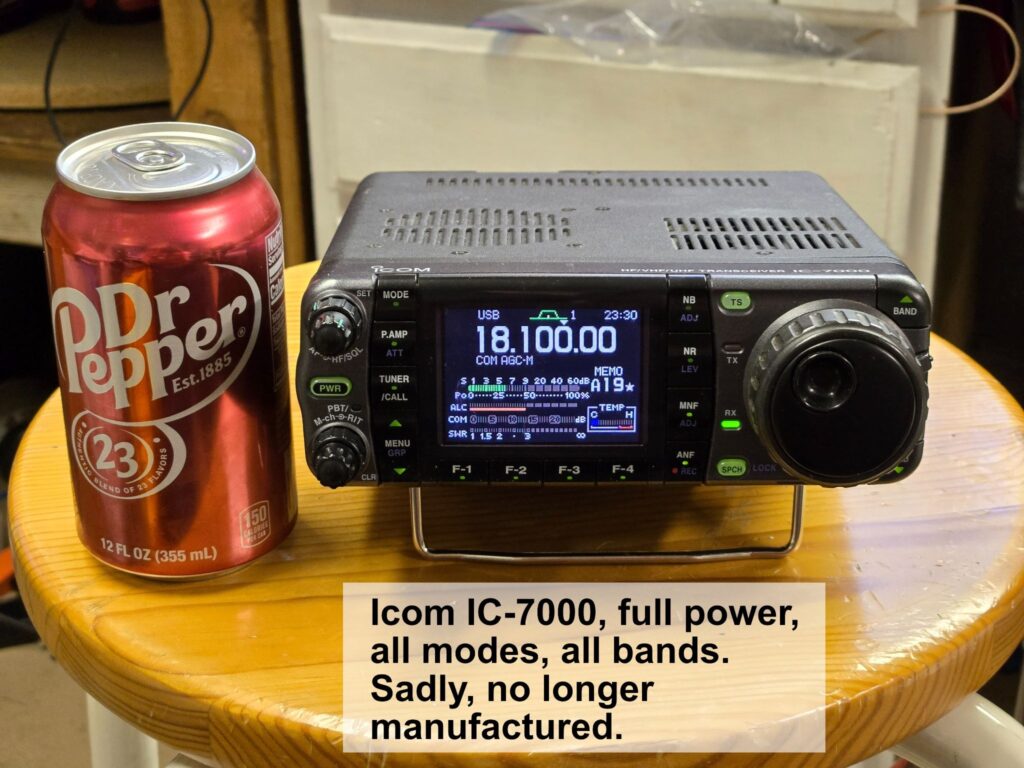
Of course, other major manufacturers have offerings in the same size and price class, and I assume that they are equally desirable, though I don’t have any direct experience with them.
Any 100 watt transceiver in such a small package will tend to run a bit hot. So if you’re doing digital modes like FT-8 it’s a very good idea to dial the power back to 50% or so.
The other approach is one of the low power transceivers, probably with an outboard amplifier.
The Yaesu FT-817/818 family is one very well liked solution for all modes 160 meters to 70 cm. These can be found for around $450-550, so if you are happy with 4-5 watts, this solution is a bit easier on the pocketbook. You can have HF contacts at this power level, even international DX at times, but it takes a good antenna and more patience. Having access to 2 meters fills the local communications need, and a few watts are often enough.
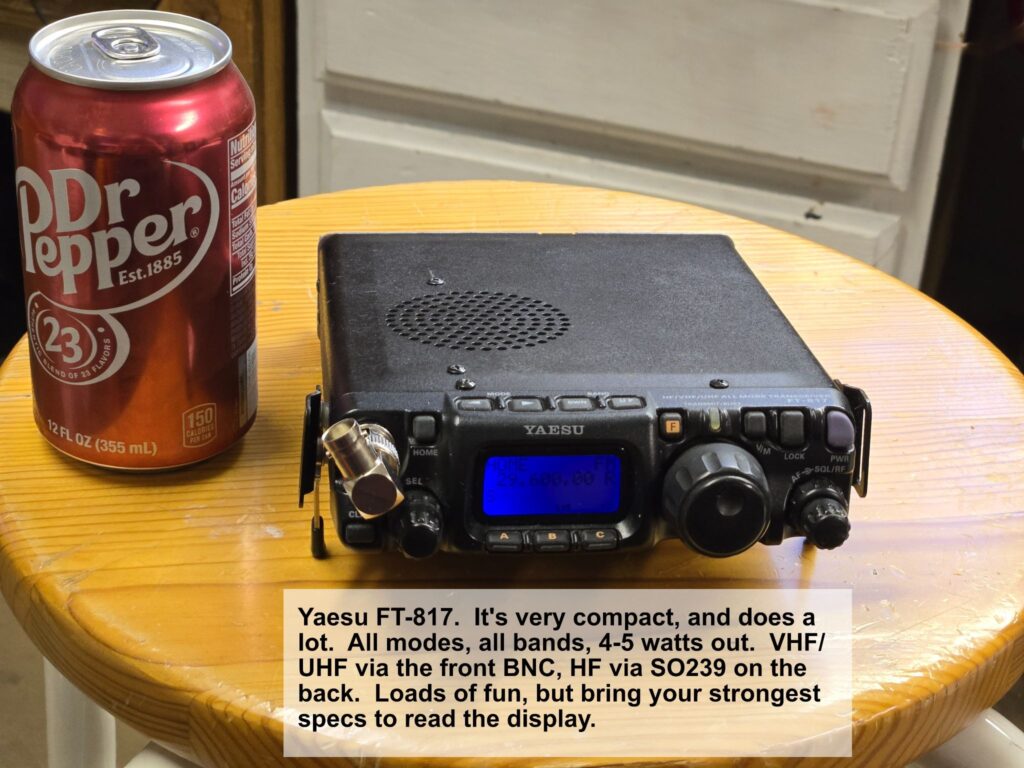
When I do POTA, I like to run 25-35 watts. Adding the PA-50-3 50 watt HF amplifier does this and more, for a cost of about $200. That puts this solution in the same cost range as the all-in-one 100 watt transceivers mentioned earlier.
The Qrp Labs QMX+ shows that a 3-5 watt HF transceiver can be built and profitably sold for under $250. That may yet shake up the market. SDR radios are less expensive to build than superheterodyne designs, yet they continue to command traditional superhet prices. In the meantime, QMX+ is very much a work in progress, with firmware bug fixes posted about monthly, and persistent internal spurious signals. The Xiegu 6100 and 6200 are reputed to be comparably buggy.
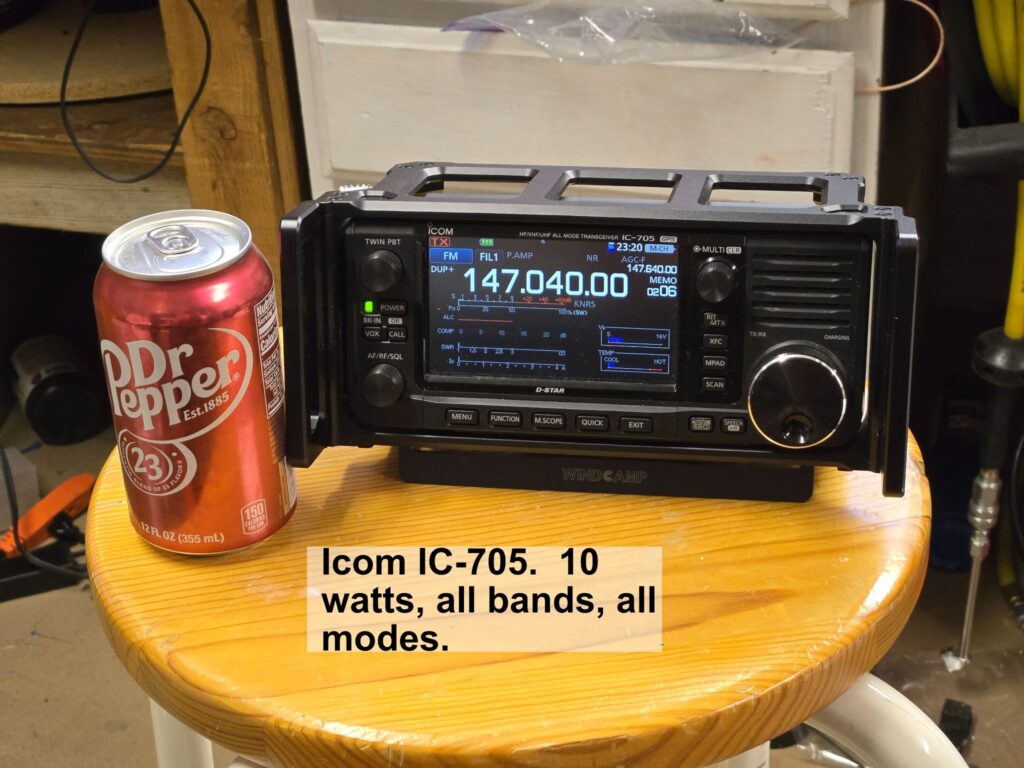
Probably the most expensive solution is the IC-705 plus an amplifier. I have a love-hate relationship with that solution. It’s small, but bigger than I would like, and it includes the expensive digital voice function which seems to be a solution in search of a problem. On the other hand, it is very smooth, well designed, does up to 10 watts, covers 160 meters-70 cm all modes and has a snap-in battery that will let you run up to 5 watts for quite a while. It’s a pleasure to operate. Dial the power back to about 2.5 watts, and it will drive the little Chinese amplifier quite beautifully.
LiFePO4 batteries are clearly an excellent choice for portable operation. Unlike the older lead-acid batteries which can safely supply about 50% of their watt-hour rating, you can comfortably extract 80% of the rating from this newer alternative. The IC-706 draws 1.5 amperes on receive and peaks of 20 amps on SSB transmit, with an average transmit draw of about 9 amps. So if you spend half your time talking and half listening, your average draw is a bit over 5 amps, and a 20 amp-hour battery should last 3+ hours. The same setup should run the QRP rigs and outboard amplifier for twice that or more.
If you ever plan to take your kit on an airplane trip, listen up: You must take Lithium based batteries in your carry-on baggage. Most airlines will accept 2 batteries, each up to 160 watt-hours, but this varies from airline to airline, and some require advance notice. Also, don’t assume that TSA will multiply amp-hours x voltage to get watt-hours. Choose batteries that are marked with their watt-hour rating. I have two 10 amp-hour batteries in case I get to operate from some exotic location like, you know, Scipio or Idaho Falls.
Tell us about your portable kit, and what works for you. Send me a Word document with pictures or click on COMMENTS below. dənŧòn(at)tutanota(dot)com. Scrambled my name a bit to avoid robots that scrape email addresses, but it should be clear enough to humans.
73 for now,
Denton