
Today’s Whimsy
My usual mental fountain of limericks is on vacation in Bora Bora at the moment, so here is a bit of whimsy from the May, 1944 QST. QST had a sense of humor. Who knew?
The Radar Man
If you should see upon the street
A man equipped with dipole feet
And a family of curves trailing behind,
He’s a Radar Man with a micromind.
His eyes take on a neon glow,
His ears extend to a yagi beam,
His mouth becomes another pulse gate,
And his heart pumps blood at a video rate.
With microseconds and microwaves
and microvolts he fills his days.
And thereby, in the course of time,He develops a micromind!
This Radar Man, with the passing years,
Attains infinite impedance between his ears.
And finally succumbs to a heavy jolt
When he gets what he thought was a microvolt!
The doctor looked up from his microscope,
Turned to his colleagues and softly spoke.
“No single trace of a brain can I find
He’s a Radar Man with a micromind!
What Kind of Tuner? Where?
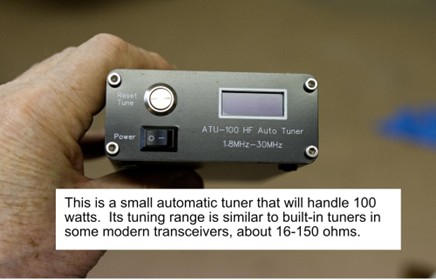
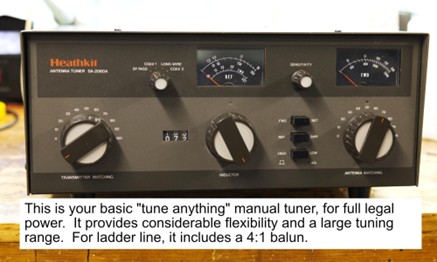
There was a time, long ago, when transmitters were designed to match a range of impedances. No longer. Today, transceiver output is universally fixed at 50 ohms. With that, we need some way to handle antennas that are not close to 50 ohms. One solution to the problem is a tuner. The question to be answered is, what kind of tuner do I need, and where do I put it?
Loss From Reflection
If you have a 75 ohm dipole, and feed it from a 50 ohm source, some of the signal will be reflected back to the transmitter. This is fundamentally no different from a ray of light being partially reflected from a sheet of glass. Of course, the reflected energy is not radiated, and may well end up being dissipated in the final amplifier stage of the transmitter. It is the job of the tuner to adjust voltage, current, and the phase angle between them to compensate for mismatches so that transmitter power is converted to radiation.
Loss From High SWR In Coaxial Cable
You will always have some basic signal loss in your coaxial cable. But if your SWR is high, and your tuner is located at the transmitter, you will incur additional cable losses that the tuner can’t fix. If the tuner is at the antenna feedpoint, and doing its job, then you only have the basic loss. That is why placement of the tuner sometimes matters.
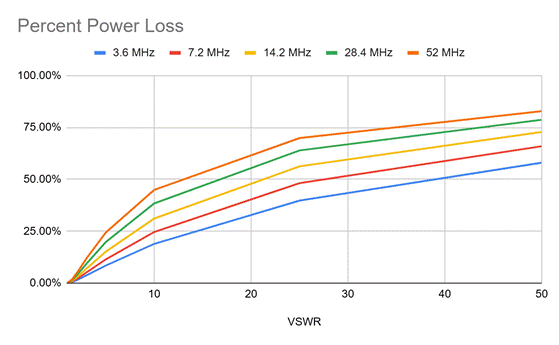
So what is the price for putting the tuner at the transmitter rather than at the feedpoint? Here’s a graph and table of the data for a typical setup, using 50 feet of RG8X:
| Additional Power Loss in Cable Due to SWR, 50 Feet RG8X | |||||
| VSWR | 3.6 MHz | 7.2 MHz | 14.2 MHz | 28.4 MHz | 52 MHz |
| 1 | 0.00% | 0.00% | 0.00% | 0.00% | 0.00% |
| 1.5 | 0.48% | 0.67% | 0.92% | 1.26% | 1.64% |
| 2 | 1.42% | 1.98% | 2.70% | 3.71% | 4.79% |
| 3 | 3.71% | 5.09% | 6.91% | 9.30% | 11.83% |
| 5 | 8.44% | 11.43% | 15.14% | 19.74% | 24.37% |
| 10 | 18.90% | 24.60% | 31.10% | 38.38% | 44.92% |
| 25 | 39.74% | 48.13% | 56.24% | 63.92% | 69.87% |
| 50 | 58.01% | 65.92% | 72.83% | 78.69% | 82.86% |
So what do we learn from all this?
- If your SWR is 3:1 or less, there is little difference between putting the tuner at the transmitter and putting it at the antenna feedpoint.
- With 3:1 SWR or better, and the tuner at the transmitter, the little automatic tuner, the big manual tuner, or the tuner built into some transceivers will all give you a match. By transforming the unmatched impedance, they will also keep the foldback circuit in your transceiver happy, and allow you to run full power.
- If your SWR is high, you’ll get better results with the tuner located at the feedpoint. Tuners are not 100% efficient, but most are quite good. With the tuner at the feedpoint, you can have a very efficient system even if your SWR is high.
- Does the tuner just “fool the transmitter”? Emphatically, no. If all you want to do is fool the transmitter, insert a 3 dB attenuator at the transmitter output. Your antenna will be as mismatched as ever, but your transmitter will never see more than 3:1 SWR.