
How We Won WWII
1939 was an interesting time to be a ham, more interesting “uh-oh” than interesting “how fun.”
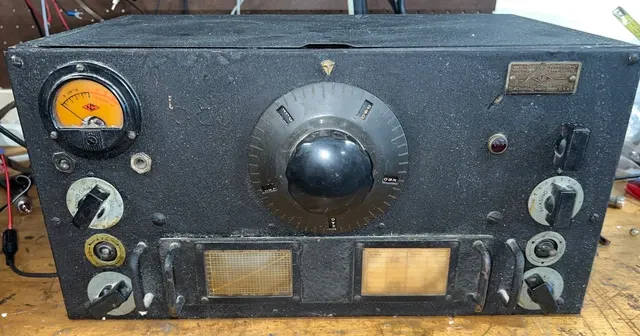
Heinrich Hertz’s experiment demonstrating the existence of electromagnetic radio waves was only about 55 years in the past, still within living memory. Yet spark had come and gone, and CW was king, with AM communication also in the mix. AM broadcasting was still in its youth. The invention of the superheterodyne receiver 21 years earlier greatly improved receiver capability. The National HRO receiver was state of the art, and had been on the market for a few years, at a price a little under a month’s salary for an engineer.
Germany’s infamous Kristallnacht had happened late the previous year, and World War II got underway in earnest in Europe during August. In Asia, Japan’s conquest was well underway.
In the UK, fears of clandestine communications with enemies on the Continent led to the complete shutdown of amateur radio, and confiscation of both transmitting and receiving equipment.
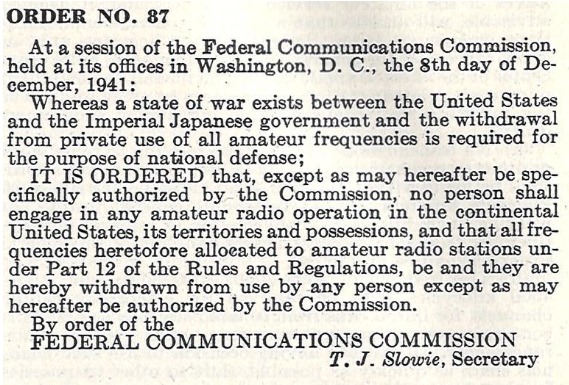
Amateur radio would endure until 1941 in the USA, with severe restrictions on DX contacts. Then came December 7.
Amateurs were eagerly accepted into the military as radio operators. They already knew a bit about HF propagation, antennas, and equipment maintenance, plus they were already skilled at Morse Code. It was an excellent “hiring pool” for a valuable set of skills.
What of those who could not serve in the military? Thereby hangs the rest of the tale.
The Brits had no effective way to monitor the airwaves for German or Italian message traffic. Resources were scarce. Hmmmm…. Where could we find a group of people who were skilled at Morse and experienced at copying signals off the air? Small wonder that the MI8 intelligence service turned to Arthur Watts, the President of the Radio Society of Great Britain. He willingly went to work selecting amateur radio operator candidates throughout the country.
If you were a ham, and too young for the military, or a woman, or too old, or in a wheelchair, you might well receive a letter from a fictitious person or a visit from a police or military official asking if you were willing to do some secret work for the war effort. Many accepted that calling and Britain soon had about 1,500 Volunteer Interceptors working under the Y Service. Entering the program meant signing an agreement to never divulge what you were doing even to your family. The good news was that you got your receiver, or perhaps a better receiver, to work with. People in the program typically worked from home, though a few were sent to Ceylon, Cocos Island, Karachi, Casablanca and Cairo.
The initial mission was to search for foreign spies in Britain transmitting messages back to Germany or Italy. That quickly proved fruitless, as there were no spies to be found. But the VIs did regularly come up with pages of cryptic 5 letter groups. It turned out that they were intercepting German and Italian military message traffic encrypted by the Enigma machine, which the Axis powers thought was undecipherable. Collecting those messages soon became the VI’s main task.
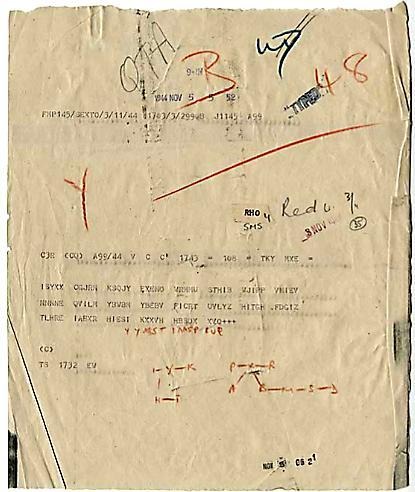
By 1941, VIs were submitting 10,000 pages of encrypted traffic per day to Arkley View, the drop off point. Those pages then quickly went to Bletchley Park where Alan Turing and his group had indeed broken the codes. By the end of the war, Allied commanders were sometimes getting disencrypted traffic before their Axis counterparts. And the raw material for that intelligence? Hours and hours of dedicated listening and hand copying CW, done by a corps of dedicated volunteer amateur radio operators.
For our freedom, we owe debts to many people who served in many ways. Not the least of these are the debts to three Polish mathematicians who reverse engineered and hand built a copy of the Enigma machine and gave it to the Brits, the cryptographers of Bletchley Park who broke the German code, and 1,500 British hams, many of them teenagers, who copied reams of CW daily and sent it in for disencryption.
73 for now,
Denton
W7DB